

So I finally tried something new. My brother, Brett Young, bought me a secret gift. Here is a short story of my first time tasting the thrill of flight.
It's around 3:00 PM this afternoon (September 18, 2017) and Brett says "Ok, we need to wrap up early today. We are heading down to the Market Common."
Now, the Market Common is a retail center that ascribes to the New Urban Design esthetic. The streets have wide sidewalks lined with trees and shrubs. Busy shoppers are shuffling from store to store staring into heavily designed window displays. The bottom floor of the buildings, with traditionally styled exteriors, feature retail shops with posh name brands and expensive restaurants. The upper floors are apartments where hipster types water topiaries on their balconies overlooking the bustling streets below.
This community is a new and strange development for the Myrtle Beach area which usually builds standard suburban communities that sprawl. The area visually invites you to start walking around and exploring. If I weren't lazy, I could see myself jogging the track around the pond. Looking back, this was my first real brush with New Urbanism, the same walkable, human-scaled design thinking behind the Commonway System and Rosetta Places today.
I love heading down to the Market Common and slipping in-between the shelves of Barnes and Nobles with the fresh scent of new books wafting around. I'll grab a chai tea latte and pick the latest illustrated Star Trek-themed book, find a chair, and drift into a future universe.
So when Brett says that we are heading down to the Market Common, I am all in. What I didn't know was that he had a secret plan. You see, the Market Common was built in place of a retired air force base and abuts the back side of the Myrtle Beach International Airport. If you plan to fly your Cessna or private jet, you must drive through the Market Common to get to the General Aviation terminal. While Brett was honest, the secret detail he left out was that I was going to the Myrtle Beach Academy of Aviation located at the airport.
You missed your turn
As we are driving around presumably looking for a parking space, Brett turns the car down a somewhat industrial looking street.
"I am not sure this is where you want to park," I quipped.
Brett pulls into a parking lot at the end of the street. There are two sizeable grey airport hangars filled with various workers repairing small aircraft. I am thinking that Brett is just using the parking lot as a place to get the car turned back around. But, instead, he parks the car.
Something must be up.
As we walk into the lobby, replete with chairs and a coffee table, a friendly receptionist peeks out of the customer service window and asks if I am Kevin. I was about to answer when Brett stepped in and said "Yes, he is Kevin and I'm his brother. We spoke on the phone earlier. I am dropping him off and will be back to pick him up. About how long will this take?"
I knew what gift precisely Brett had in store for me. The Academy of Aviation has a package called a Discovery Flight that I've been salivating over for some time. The Discovery Flight serves as an introduction to flying. It is half educational and half fun.
Now some people aren't interested in learning to fly, but I have always wanted to try it, and Brett knew that I would love this opportunity. I could feel the excitement pulse up my back as my heart started to speed up. I tried to keep my composure and even bit my lip. I kept thinking, "Ok, Kevin let's keep this under control."
Meeting Rusty
Meanwhile, the bubbly receptionist said, "I'll call Rusty, your instructor, and let him know that you are here. Go ahead and take a seat."
While waiting to meet with Rusty, I was contemplating the reality that was soon about to unfold. I remember reading the web page for the Discovery Flight package. It says, "you'll get approximately 30 minutes of ground school with your instructor and learn what to expect once you're airborne. You'll also get an amazing 40 minutes to spend soaring through the skies and experience the thrills of flight!"
That, however, is not exactly how things went down!
Rusty, a retired Ohio police officer and seasoned flight instructor, was laid back wearing jeans and a button-down shirt. He sat me down in a tight conference room with a dominating table. Showing a confidence that eases the nerves, Rusty assures me that my experience will be safe and fun. I could tell that he is knowledgeable and experienced.
The instructor job fits him well. You can tell that he loves teaching people as much as he loves flying.
While holding earmuffed headphones in his right hand, he looked me in the eyes and asked, "How are you when it comes to bumpy flights? Do you get a little queasy or nervous?"
Wow, what a way to start!
We spent a couple of minutes talking about expectations, and concepts that are all new to me. Like, taxiing the plane and rotating the yoke. I remember asking a few questions for clarification as I had no idea of the terminology Rusty was using.
Another employee of the school popped into the room and apologized to me for interrupting our lesson. They spent about ten minutes talking about an incident that occurred a few days prior. The kind of thing where typical government bureaucracy at the airport fell apart and Rusty pulled no punches while rectifying the situation. His colleague was a bit chatty and impressed with the way Rusty handled the matter.
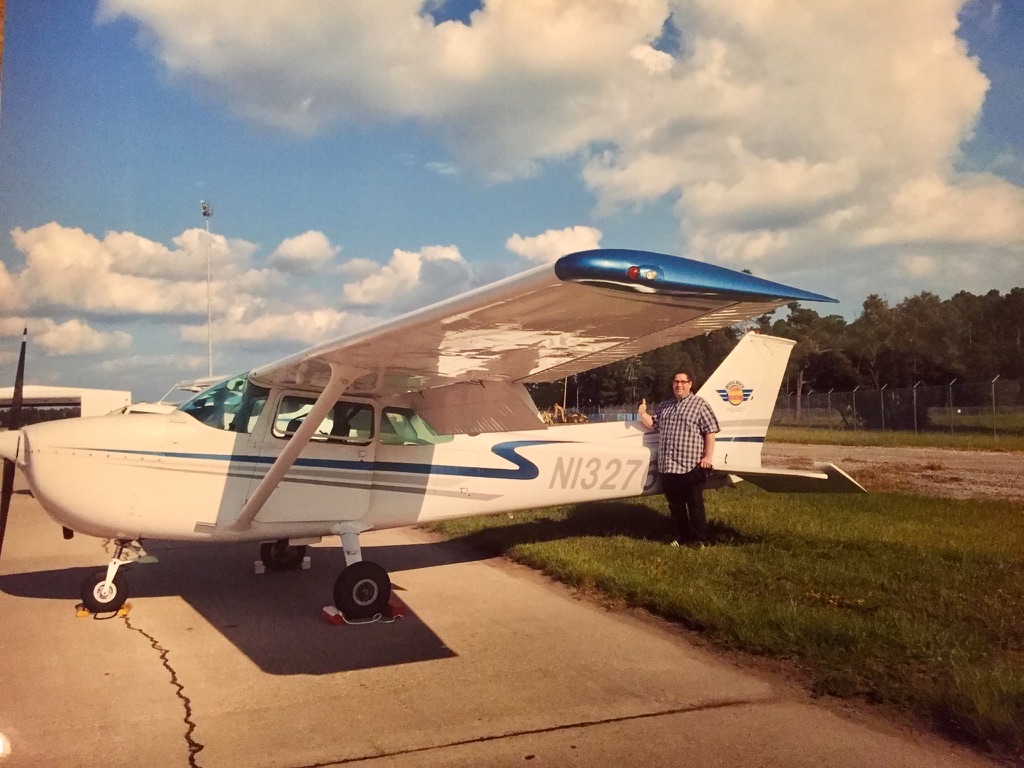
Hoping that we didn't lose flying time, I didn't resist when we got up and started walking out to the plane after only receiving about 10 minutes of my ground lesson. Once we got out to the Cessna, the bubbly receptionist met with us and had me pose in front of the plane for a photo.
Please fasten your seat belts
Not long after, Rusty and I are sitting in the Cessna's cabin going over the preflight checklist. I am reading step-by-step instructions from a card, while Rusty is flipping switches and checking status indicators on the massive instrument panel before us. He waits as I spurt out the next instruction before he performs it.
After getting strapped in and testing our headphones, he tells me that he will handle all the communication with the control tower. He mentioned that the chatter may get overwhelming but that I should not get anxious about it.
Up until this point, I was under the incorrect assumption that we would be flying out of some learning runway separated from the main airport. I was wrong.
The pressure I was feeling was starting to rise, but I trusted Rusty and felt safe under his tutelage.
Rusty said, "We are now going to taxi the plane over to the runway. Do you remember what I told you about the foot pedals? We are going to use them to direct the plane where we want it to go."
So while a plane is on the ground, you must taxi (or drive) it around using foot pedals, there is no steering wheel. Taxiing usually takes first-timers like me a little while to learn. The goal is to align the nose of the airplane to follow a bright yellow stripe painted on the tarmac.
It sounds simple until you realize that the pedals work under different principles than their automotive counterparts. They are connected to each other. When you push one pedal in, the other pops out in an equal and opposite reaction. They are used to steer the plane left or right. To complicate matters more, the pedals also act as brakes to stop or slow the aircraft. Each pedal can be swiveled upwards to activate the brake.
You can see how a person who has only driven a car could be a little overwhelmed by these pedals.
Now everyone who knows me well knows that I am a bit of a talker. There are only a few times that I shut up; eating, sleeping, watching Star Trek re-runs, and becoming absorbed in something tech related usually does the trick. So saying that Rusty saw me in rare form is an understatement. I was so engrossed in learning everything that I hardly spoke a word.
When Rusty asked me questions, I kind of grunted one-word answers. He had no idea that I could form whole sentences. I was just taking everything in, and it was overwhelming and compelling. I wanted more but I was also feeling a healthy fear. I didn't want to forget some vital instruction, mess up and cause our deaths. We are about to fly a plane after all.
The strange jargon didn't help me either. Pilots have some private lingo that replaces regular English. For example, it's not a steering wheel; it's a yoke. Another example includes what I wanted to call a dashboard, but is appropriately referred to as an instrument panel. Even maps have a particular name; they are called sectional charts.
After a little bit of practice with the steering pedals, I was starting to understand how to taxi the plane. Rusty would let me know when I was doing good and conversely when I was straying from the all-important yellow stripe on the ground.
I couldn't believe it. I was essentially driving a plane. I even heard Rusty say, "Good, you're getting the hang of it!" I think he was more relieved than I was.
We were nearing the runway as Rusty informed me to stop the plane. He was calling to the tower in another foreign language in which every letter must be spoken like a word. He would say "Zulu" for the letter "Z" and "Niner" for the number "9." We've all heard this in movies, but I heard it real-time.
Between the bits of radio chatter, you could hear the sound of the propeller whipping through the wind. The plane slightly vibrated to the dull roar of the engine. I couldn't help but wonder how this little airplane was held together. Just then, Rusty pointed directly ahead out the front window. Across from us was a commercial passenger jet getting ready to take off!
"It's not every day that you see a jet head on," he said with a little chuckle.
Moments later the Allegiant Airline jet, which probably was carrying some 200 people, started taxiing down the runway. Suddenly I realized, this is legit. This is going to happen. Holy Crap.
Return your tray table to its full upright position
Surely, Rusty is going to handle the takeoff. That is what the website said was going to happen, right? I'm sure it said something about, "once you're airborne...you'll...experience the thrills of flight!"
Wrong again.
The control tower gave the signal for us to take off. I remember looking down the runway and still seeing the Allegiant jet on the ground or at least a couple of the wheels were. So how could it be our turn, they are still here?
Rusty reassuringly says, "You have nothing to worry about. This runway is two miles long. We only need a few feet to take flight. We could take off and land several times before the end of the runway." I almost grumbled under my breath, "that is a distinct possibility."
So Rusty had me start taxiing the plane onto the runway while he reached down and pulled on a cylinder-shaped rod. This appeared to increase the speed of the propeller. I think it was called a throttle or pitch control, but I am not entirely sure.
Once aligned straight down the runway he said, "I will take over the foot pedals and keep us going straight. Now, remember, when I say 'Rotate,' you will pull that yoke toward yourself as we talked about."
Only seconds pass and we are moving pretty fast. Rusty yells out, "Rotate. It's time to rotate."
Now, this is another terminology thing that can be confusing. Usually, when you hear the word "rotate," you think to turn a wheel clockwise or counter-clockwise. That is not the case with the yoke of a plane. Instead, you must pull the entire yoke toward your body. When you do this, the nose of the airplane raises and points upward. Contrastingly, when you push the yoke away from you, the nose lowers and the plane descends.
So as commanded, I rotate. The nose of the plane lifts upward as planned. My goal is to have the nose lined up with the horizon. Very quickly it was lined up and Rusty then said, "Ok, that's good there."
I was just about to ask how long it will be until we take off, only to realize that we were already off the ground.
My inner monologue was celebrating, "That's it. Woo Hoo. I just took off. I'm flying a plane."
Rusty was observing me and told me, "Now we need to keep ascending until we reach 2000 feet."
I asked, "How do you know how high you are?"
Rusty points to the plane's altimeter and says, "You see the little white triangle? That is 2000 feet. You're almost there."
The control tower chimes in and we are now supposed to make a left turn. Apparently, all airports use a leftward circling traffic pattern on entrance and exit of the airspace.
Turning a plane may sound like no big deal and you are correct, it isn't. Except that, unlike making a turn in a car or truck, the whole airplane banks at an angle for the turn. Banking the aircraft summons one of those sour feelings in your stomach just before you find yourself spewing your lunch all over the place. Thankfully, I did not hurl.
Rusty now explains that pilots usually bank at a 30-degree angle because anything more would make their passengers uncomfortable. That's a helpful tip.
Now we straighten out as we head southward. Rusty lets me know that Murrells Inlet is dead ahead. I loved this new perspective of the world.
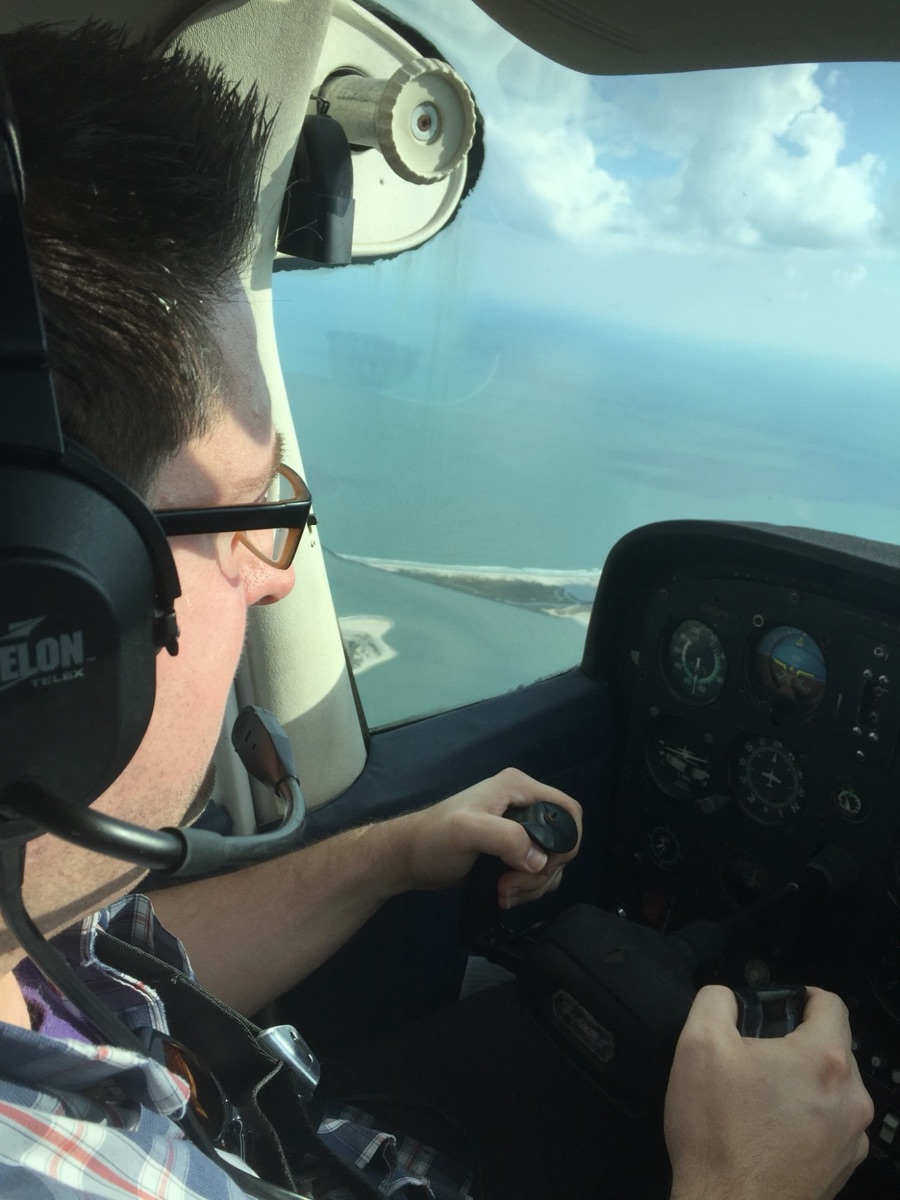
Here we are, mid-flight, the sun piercing through the countless clouds floating like icebergs above us and the Atlantic Ocean with its blue-green hue sparkling off to the left. Looking out towards the horizon, this beautiful tan strip goes on and on separating the water from the lush green forest on our right. You can understand why locals call this area the Grand Strand. The wonderment took over. I felt like a little child running around outside on a beautiful day. Lost in an imaginary playland, never wanting reality to take me back. What a beautiful planet we get to call home! What a great gift this flight is and a great gift our earth is. Let me not forget that.
Eyes back on the road, er sky
Rusty now taps his finger on the altimeter to remind me that we are starting to descend. "You need to keep us at 2000 feet," he cautions.
Remembering that "rotating" the yoke sends us upward, I gave it a pull.
"Whoa, whoa," Rusty says, "pull it gently. We do everything gentle." The airplane is racing upward. We finally level out.
He can see that I am holding the yoke tightly.
"Kevin, why don't you let go of the yoke for a moment. See. Nothing is happening; the plane will continue along just like that. You don't need to hold on so tightly. Just hold it with your fingers and keep us level."
Coming in for a landing
We flew around for some time, Rusty had me perform other turns and he taught me how to make a controlled descent and had me bring the plane back up. But all good things...
I was hoping that Rusty would perform the landing, but that is something I will be learning too. As we approached the airport, he pointed to a black strip on the ground that marked the beginning of the runway. It was still a bit off in the distance. We began a controlled descent toward that landing strip. It was rewarding to know that I remembered how to perform one.
As we neared the landing strip, we made our required left turn. Everything was surreal.
Now Rusty wanted me to slow down the propeller a little more and rotate the yoke. Rotating the yoke seems counter-intuitive because the nose of the plane lifts upward instead of down.
On the inside, I am very nervous. I look calm like a duck on the water, but underneath, I am paddling like the dickens.
Anticipating at least a bump, I was about to ask when the touchdown would happen.
Rusty then says, "You can let go of the yoke, we are on the ground. We need to taxi now, so follow the yellow stripe off to your left."
Apparently, I wasn't quite getting it, so Rusty says, "You don't need your hands on the yoke anymore. Remember, you use the foot pedals for taxiing."
"Oh yeah," I mumble back.
I have to say that while I loved every minute of the flight, I was delighted to be back on land. It wasn't long before we were shutting things down and walking back to the hangar that housed the school's offices.
This guy really was a great teacher. Not everyone could get me to operate something so complex and potentially dangerous without coercing me first. He had a way about him that made you feel safe and put you at ease. I hope he never decides to sell timeshare.
I made a point to thank him, not just for teaching me but for putting up with me.